Quick Summary
Wellness centers often struggle with fragmented systems for client management, scheduling, and marketing while staying HIPAA-compliant. But the best CRM software for wellness is an all-rounder. It combines client management, HIPAA-compliant documentation, marketing automation, and scheduling in one platform.
Build Growth and Loyalty Through the Right CRM Platform
Running a wellness center is a complex, multi-faceted operation. It involves managing clients, providers, schedules, and marketing, often simultaneously. But the best CRM software for wellness centers brings cohesion to that complexity.
With more wellness centers opening each year, standing out requires more than great treatments. It needs smart systems. For instance, a purpose-built CRM can centralize client data and automate follow-ups. It also gives you the clarity you need to make confident decisions.
This guide covers 11 CRM platforms suited to wellness businesses. We break down their features, integrations, and pros and cons so you can find the right fit for your health spa.
Why Listen To Us

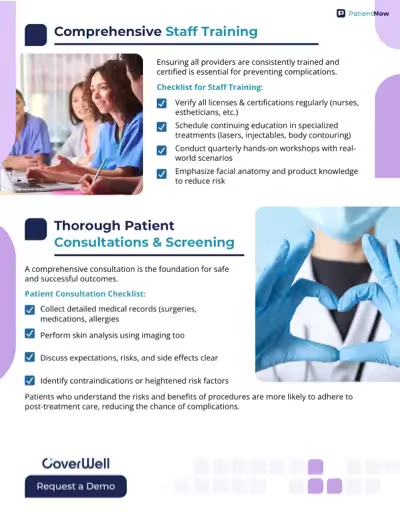
PatientNow has served aesthetic and wellness practices for over 20 years. Our award-winning team works alongside med spas, wellness clinics, IV therapy centers, and weight loss practices daily. We understand the operational, clinical, and marketing challenges these businesses face, and base our recommendations on proven experience, not hearsay.
What Is CRM Software for Wellness Centers?
CRM software for wellness centers is a platform that helps manage a wellness practice. It stores client records, automates marketing, and tracks treatments. CRM platforms also handle bookings and billing.
In short, it streamlines operations and boosts patient retention. Ideally, it should do all this while meeting compliance requirements.
Benefits of CRM Software for Wellness Centers
Here’s a quick run-through of the benefits of a good wellness CRM software:
- Centralized client data: All history, preferences, communications, and treatments in one place.
- Automated marketing: Drip campaigns, review requests, and SMS follow-ups without manual work.
- Improved client retention: Automated recall and loyalty tools keep clients returning.
- Operational efficiency: Scheduling, booking, and billing in one streamlined workflow.
- Clinical compliance: HIPAA-compliant documentation for medical wellness practices.
- Revenue visibility: KPI dashboards that show what is actually driving growth.
A Snapshot of 11 Leading CRM Software for Health Spas
Below is a quick comparison of the top wellness CRMs:
#ToolKey FeaturesHIPAA1.PatientNowMarketing suite; AI booking automationYes2.MindbodyClassPass marketplace; Smart marketingPartial3.ZenotiAI staff assistants; Multi-location reportingYes4.HubSpot CRMEmail drip campaigns; Sales pipelineAdd-on5.Salesforce Health CloudPatient 360 view; Automated journeysYes6.ActiveCampaignWorkflow automation; Multichannel campaignsAdd-on7.Zoho CRMContact management; Campaign trackingAdd-on8.KeapAutomated follow-ups; Built-in invoicingHIPAA capable9.AestheticsProHIPAA charting; Online booking portalYes10.Jane AppDrag-and-drop scheduling; AI ScribeYes11.VagaroConsumer marketplace; Waitlist managementPartial
Now then, let's see exactly what each platform offers:
1. PatientNow
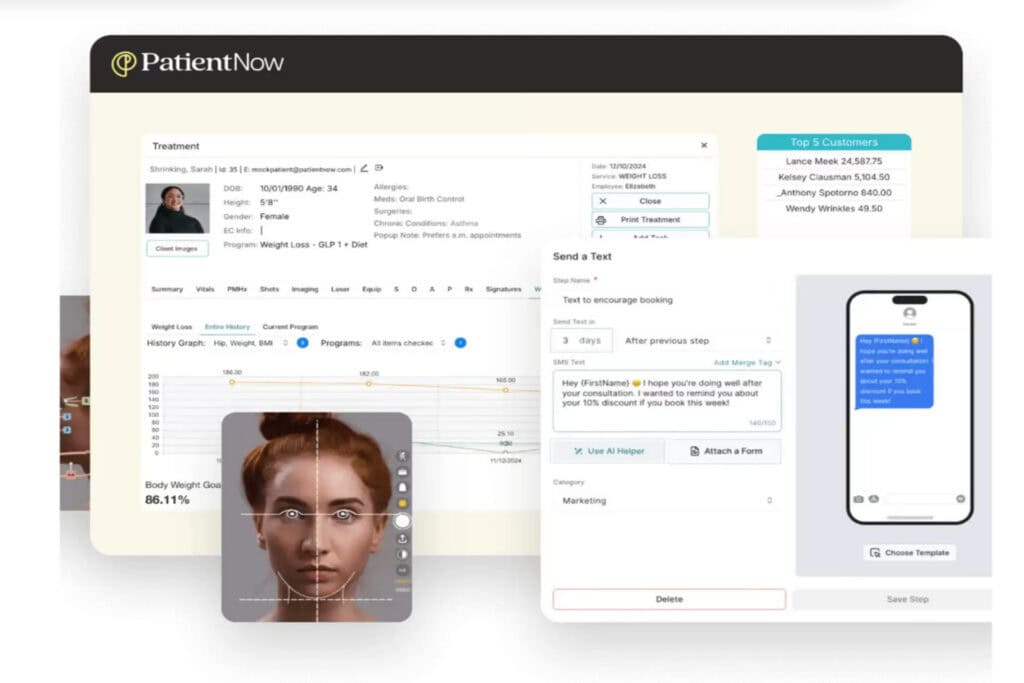
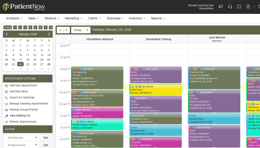
First up is PatientNow, the leader of the pack. The platform is a specialized all-in-one CRM and EMR software for wellness centers and med spas. It offers weight loss, IV therapy, and HRT. PatientNow combines sleek automation, clinical precision, and full-suite marketing in a single platform.
You don’t need to switch platforms to run your wellness practice, or, figure out countless workarounds to combine scattered tools.
Key Features
- Full marketing suite with lead capture, drip campaigns, SMS, and reputation management.
- Recura AI agents that automate booking, lead follow-up, and patient nurturing 24/7.
- Clinical-grade EMR with HIPAA-compliant charting, injection tracking, e-prescribing, and telehealth.
- Integrated QuickBooks payments with next-day funding, memberships, and loyalty programs.
Integrations
QuickBooks, Canva, 120+ lab vendors, Tippy, RxPhoto, and Recura AI.
Pros
- Purpose-built for clinical wellness, not a retrofitted salon tool.
- Replaces 4–6 vendors with one integrated system, reducing cost and complexity.
- U.S.-based support team with deep aesthetics industry expertise.
Cons
- Overkill for very small solo practices.
- Needs training to master (available for free).
2. Mindbody

Secondly, there’s Mindbody, a respected CRM in the wellness space. It’s built primarily for fitness studios, spas, and wellness practices. The platform offers easy scheduling, client management, HIPAA‑compliant notes, marketing tools, reporting, and mobile business access to help streamline daily operations.
Key Features
- Online booking with consumer marketplace exposure via ClassPass (2M+ clients).
- AI-powered smart marketing to fill last-minute openings.
- AI insights dashboard with predictive analytics for scheduling and revenue.
- Integrated payments, class scheduling, and staff management.
Integrations
100+ integrations, including CRMs, fintech tools, and the ClassPass marketplace.
Pros
- Strong brand recognition in the wellness space.
- ClassPass marketplace provides a built-in lead generation channel.
- Broad integration ecosystem for general wellness operations.
Cons
- MessengerAI is not HIPAA-compliant.
- Lacks eRx, labs, injection tracking, and clinical charting.
3. Zenoti
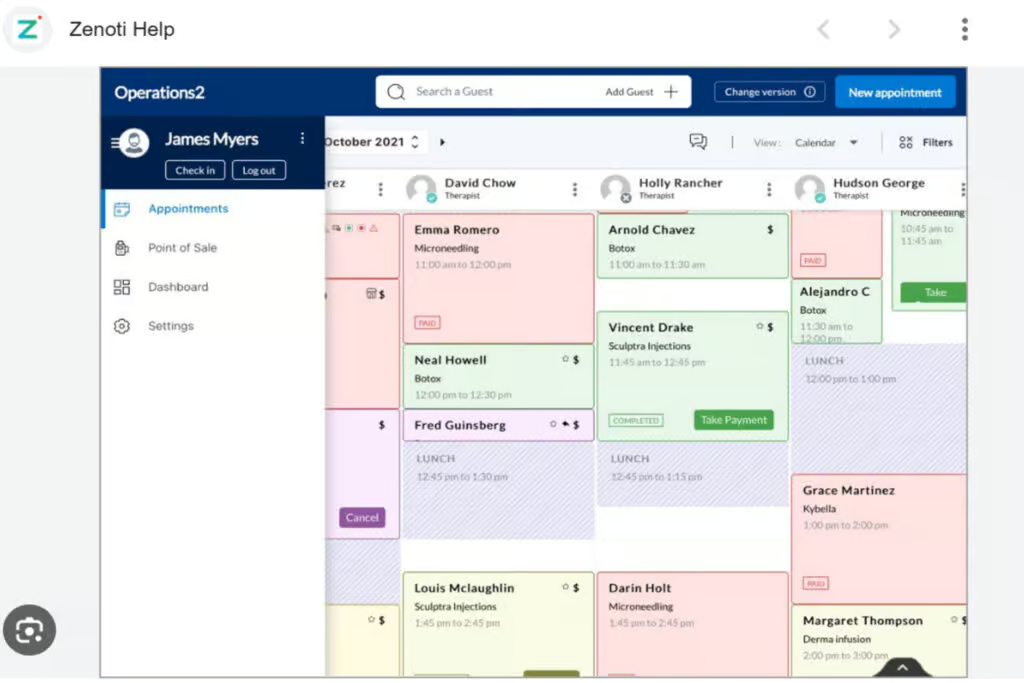
Another decent wellness CRM system is Zenoti. It's an enterprise-grade platform designed for large, multi-location wellness businesses. The platform offers advanced scheduling, brand-level permissions, and a robust AI suite.
Key Features
- SmartBot chatbot, AI Receptionist, and Zeenie in-app staff assistant.
- Multi-location reporting, federated login, and brand-level permission controls.
- AI growth dashboard for real-time revenue insights and performance tracking.
- Broad app marketplace with Shopify, QuickBooks, Zoom, and Zapier.
Integrations
Shopify, QuickBooks, Zoom, CareCredit, and Zapier via an open app marketplace.
Pros
- Excellent multi-location controls and enterprise-level reporting.
- Strong AI-first platform with multiple automation tools.
- Broad integration ecosystem for complex, multi-site operations.
Cons
- Long setup cycles of 3–6 months with significant staff retraining required.
- No labs, weight loss tracking, or advanced photo markup.
4. HubSpot CRM
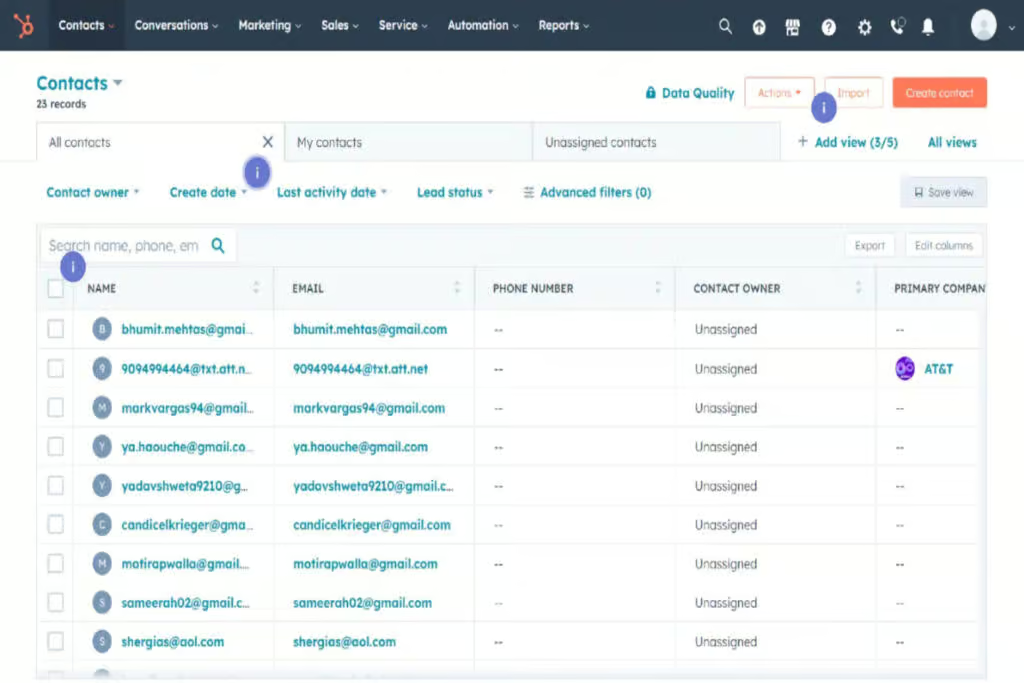
Fourthly, there is HubSpot, a widely used CRM platform. HubSpot has powerful marketing, sales, and service hubs. While not wellness-specific, many health businesses use it for lead management and client communication workflows.
Key Features
- Automated drip campaigns and audience segmentation.
- Full sales pipeline management and complete contact history tracking.
- Service hub with ticketing, live chat, and customer feedback tools.
- Detailed analytics and customizable reporting dashboards.
Integrations
1,000+ integrations via native connections and Zapier.
Pros
- Generous free tier for practices getting started with CRM.
- Strong onboarding resources and community support.
- Excellent marketing automation for lead nurturing.
Cons
- No native wellness workflows, andsignificant configuration is required.
- HIPAA compliance requires additional setup and a higher-tier plan.
5. Salesforce Health Cloud
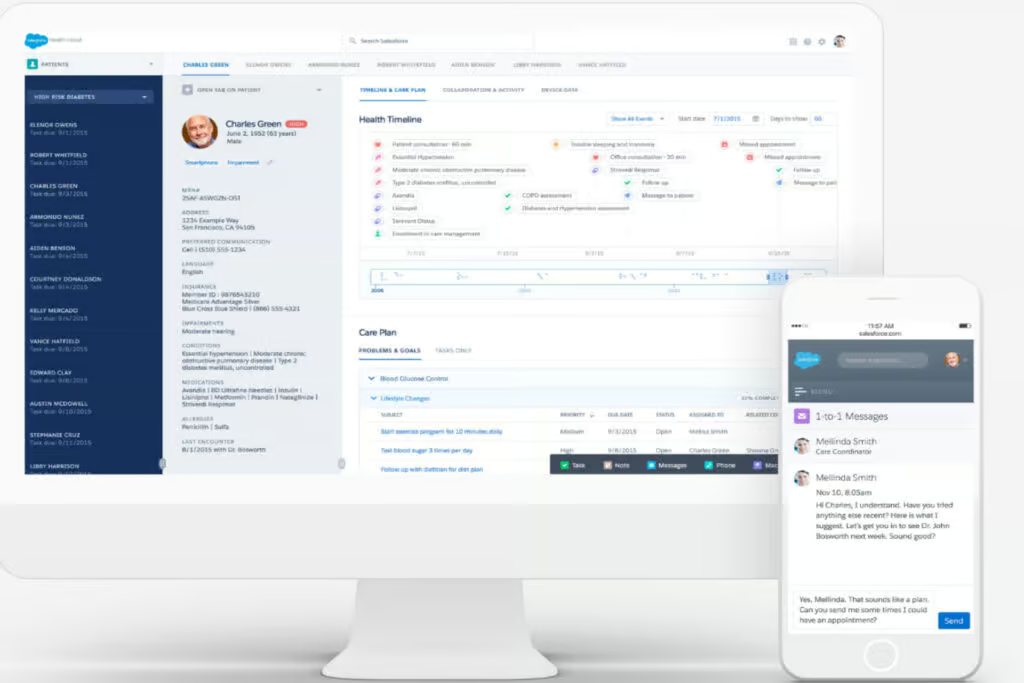
Next up is Salesforce Health Cloud, an enterprise CRM. It’s a reasonable choice for huge clinical wellness organizations. Centers that need deep customization, robust analytics, and enterprise-level data management appreciate it.
Key Features
- Patient 360 view with a full timeline, health data, and interaction history.
- Automated patient journeys and personalized outreach at scale.
- AI-powered insights via Einstein Analytics for forecasting and performance.
- HIPAA-compliant by design with enterprise-grade security controls.
Integrations
AppExchange ecosystem with hundreds of healthcare-specific integrations.
Pros
- Enterprise-grade compliance and security built in from the start.
- Highly customizable for complex, multi-specialty clinical workflows.
- Proven at scale for large organizations with diverse service lines.
Cons
- Per-user pricing is expensive for growing teams.
- Steep learning curve with long implementation timelines.
6. ActiveCampaign
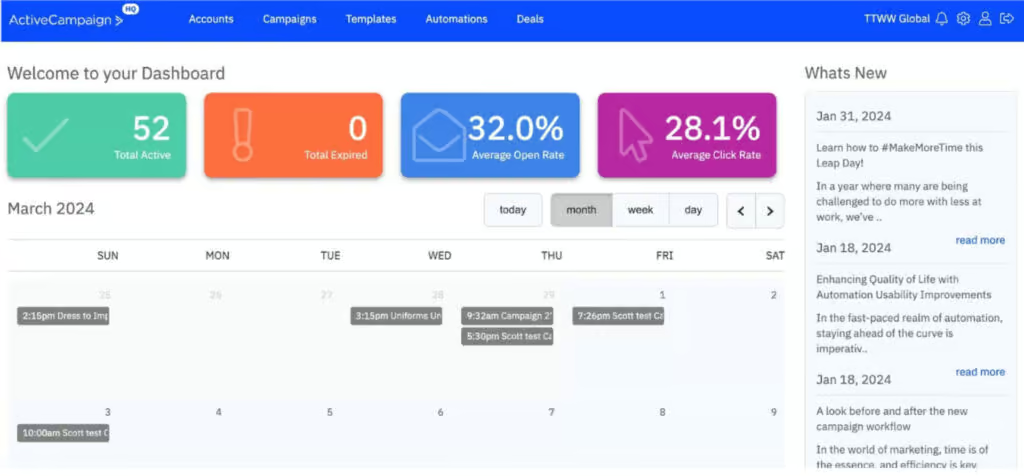
Another CRM option is ActiveCampaign, which is well‑suited for wellness centers that want sophisticated email and SMS campaigns. It offers powerful automation tools that help you build personalized email and text workflows, track engagement, and manage customer relationships more efficiently.
Key Features
- AI-powered workflow automation with advanced segmentation.
- Multichannel campaigns combining email, SMS, and site messaging.
- Built-in CRM with contact scoring, deal tracking, and sales automation.
- Detailed campaign reporting and revenue attribution.
Integrations
870+ integrations, including Google, Salesforce, Shopify, and Zapier.
Pros
- Outstanding email and SMS automation for client nurturing.
- Strong segmentation tools for targeting clients.
- Numerous integration options
Cons
- No scheduling, charting, or billing.
- HIPAA compliance requires additional configuration and cost.
7. Zoho CRM
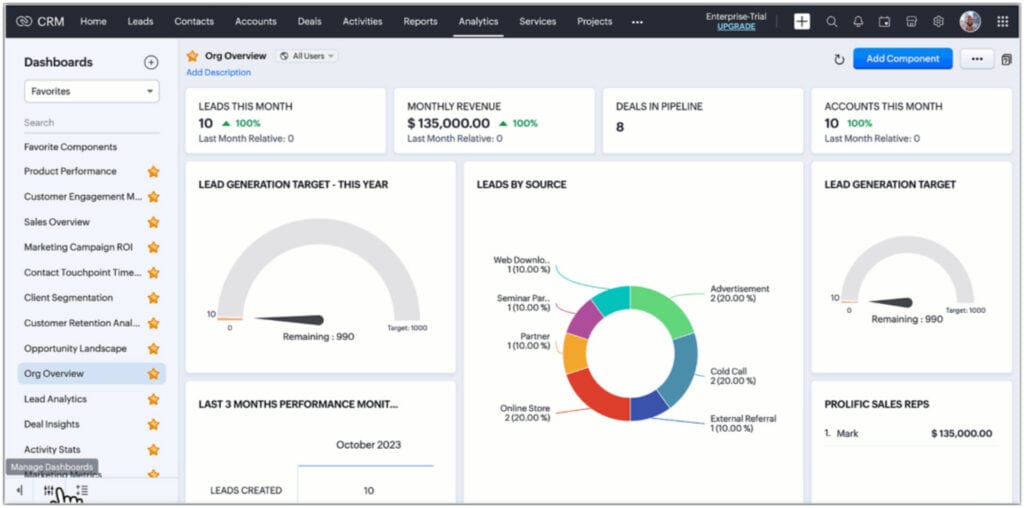
Next, there’s Zoho CRM, an affordable and flexible platform that offers workflow automation, good reporting, and mobile access so your team can stay productive on the go. You can configure it to match your unique wellness workflows. It covers lead management, email automation, and client tracking.
Key Features
- Lead and contact management with full interaction history.
- Email and social media integration with campaign performance tracking.
- Customizable pipelines, workflows, and automation rules.
- Mobile app with offline access for on-the-go client management.
Integrations
500+ integrations across marketing, accounting, and communication tools.
Pros
- Generous free tier for early-stage practices.
- Highly customizable for centers with non-standard service mixes.
- Strong mobile app with reliable offline access capabilities.
Cons
- Not wellness-specific.
- Slow customer support response times.
8. Keap
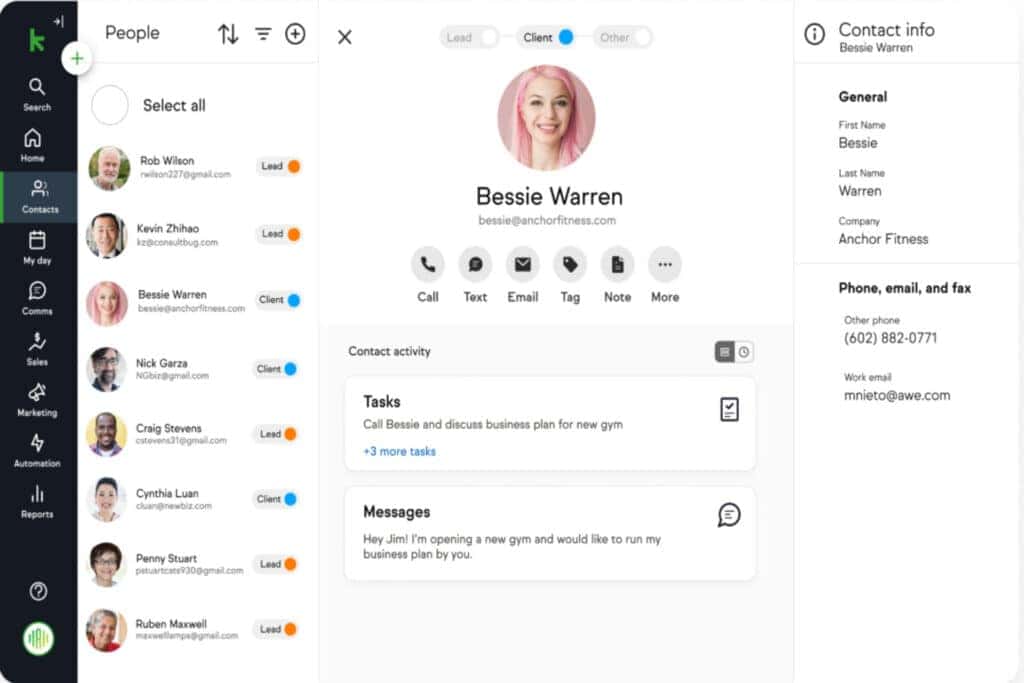
Additionally, there's Keap, a small business CRM and a marketing tool. The platform focuses on contact management and automation. Its HIPAA-capable infrastructure and broad Zapier connectivity make it a solid option for smaller wellness centers.
Key Features
- Contact management with automated follow-up sequences.
- Built-in invoicing, appointment booking, and payment processing.
- Automated lead nurturing with email and SMS triggers.
- Sales pipeline and opportunity tracking for revenue visibility.
Integrations
Google, Outlook, and 5,000+ apps via Zapier.
Pros
- User-friendly interface suited to non-technical practice owners.
- Strong automation for reducing repetitive admin and follow-up tasks.
- Broad Zapier connectivity for connecting with wellness tools not natively supported.
Cons
- No native wellness or clinical features.
- Contact limits drive up costs quickly as your client base scales.
9. AestheticsPro

Another CRM platform for wellness centers is AestheticsPro, which is a compliance-first platform built for HIPAA workflows. It offers core scheduling, charting, and client portal capabilities at an accessible price.
Key Features
- HIPAA-compliant charting and client management are built into the base plan
- Online booking, scheduling, and a client-facing portal
- Mobile provider app for iOS and Android
- Reputation management and basic marketing tools are available as paid add-ons
Integrations
Twilio native integrations are limited. eRx requires a separate portal, and there are no labs or e-commerce integrations.
Pros
- Lower per-user entry point for startups and solo providers.
- Positive reputation for ease of use and clean interface.
- HIPAA-compliant charting is included without requiring an add-on purchase.
Cons
- Marketing and patient communication tools cost extra.
- No AI innovation: reporting is static with limited dashboards.
10. Jane App

One more CRM solution is Jane App. It’s popular among smaller wellness centers, offering online booking, scheduling, charting, billing, and secure telehealth tools. The system also includes automated appointment reminders and a user‑friendly client portal.
Key Features
- Intuitive drag-and-drop scheduling with recurring appointment support.
- AI Scribe for voice-to-chart documentation.
- Client portal with appointment management, forms, payments, and messaging.
- Google Calendar two-way sync for clinician schedule management.
Integrations
Google Calendar, Mailchimp, Stripe, and Zapier.
Pros
- Strong reputation for ease of use and responsive support.
- AI Scribe integration saves charting time for clinical providers.
- Affordable and fast to implement for smaller practices.
Cons
- No native lead capture, marketing automation, or 2-way SMS.
- Weak photo tools, and no before-and-after galleries.
11. Vagaro
Vagaro is a budget‑friendly CRM for wellness practices with an easy‑to‑use mobile app for managing bookings, calendars, and client communication on the go. It also includes features like automated appointment reminders, payment processing, and access to a marketplace.
Key Features
- Online booking with consumer marketplace and individual provider pages.
- Waitlist management and client self-booking capabilities.
- Vagaro Pay Later for memberships, packages, and recurring payments.
- Full-featured iOS and Android mobile app for on-the-go management.
Integrations
Google, Facebook, QuickBooks, and Stripe.
Pros
- Budget-friendly, ideal for startups and small day spas.
- Marketplace listings provide built-in visibility for new client acquisition.
- Intuitive mobile app with full management capabilities on the go.
Cons
- Not built for medical wellness, and there are no labs, vitals, or clinical charting.
- No lead capture or nurturing.
How We Evaluated These CRM Tools
We assessed these tools across six dimensions critical to wellness center operators. These considerations were informed by hands-on industry experience and verified G2/Capterra reviews:
- Clinical depth and HIPAA compliance: Does the platform support medical documentation and compliance natively, or does it require workarounds?
- Marketing automation: Can the platform run lead capture, campaigns, and SMS outreach without third-party tools?
- Integration ecosystem: How well does it connect with labs, payment processors, QuickBooks, and communication tools?
- Pricing transparency: Are essential features in base plans, or does the real cost emerge after add-ons?
- Support quality: Is support U.S.-based and accessible, or offshore and limited?
- Scalability: Can the platform support multi-location expansion and new service lines without a platform switch?
How to Choose CRM Software for Your Wellness Center
The right CRM depends on your practice type. Here is a practical framework for narrowing your options:
Start With Clinical Requirements
Does your center provide medical services: weight loss programs, IV therapy, HRT, or aesthetic treatments? Then HIPAA compliance is non-negotiable. Confirm whether compliance is built in or requires custom configuration. Though purpose-built platforms like PatientNow handle it natively.
Assess Your Marketing Maturity
If you rely on separate marketing tools, look for a comprehensive platform. One that consolidates lead capture, campaigns, and reputation management. The cost of consolidation is usually lower than maintaining a fragmented, inefficient stack.
Consider Your Growth Stage
Early-stage centers may be served by Jane App or Vagaro.
But if you anticipate adding providers or locations within two years, choose a platform you will not outgrow. Switching CRMs mid-growth is expensive and disruptive.
Evaluate Total Cost of Ownership
A platform at $24 per month is cheap, right? However, it can reach $300 per month once SMS, email marketing, intake forms, and eRx add-ons are included. Compare total costs, not entry pricing, when evaluating options.
Transform Client Care with Intelligent Wellness CRMs
To wrap up, the best CRM software for your wellness center depends on your:
- service model.
- compliance needs.
- growth ambitions.
To make the right choice, evaluate the options carefully. Weigh if the features meet your specific needs. For growing wellness centers, PatientNow is the most complete solution. This sleek system unifies CRM, EMR, and marketing automation. It also includes AI-powered lead conversion, payments, and practice management. With PatientNow, you won’t need outside tools to run your wellness practice efficiently.
So, book a demo to see what a complete wellness CRM looks like.
Frequently Asked Questions
Still got questions? Let’s answer them:
- What is CRM software for wellness centers?
CRM software for wellness centers centralizes operations. It handles client data, automates appointment scheduling, manages memberships, and streamlines marketing and billing. For medical wellness centers, it also includes HIPAA-compliant clinical documentation and charting.
- Do wellness center CRMs need to be HIPAA compliant?
Yes, if your center provides any clinical or medical services. Once you offer aesthetic treatments, weight loss programs, or IV therapy, HIPAA compliance is essential. As an example, PatientNow comes with full compliance as a foundation, not an add-on.
- What is the best CRM for a small wellness center?
Jane App and Vagaro offer affordable entry points for non-clinical centers. But if your center provides medical services, PatientNow delivers clinical-grade tools that scale without requiring a platform switch later.
- Can wellness center CRM software replace separate marketing tools?
Yes. Platforms like PatientNow include a full marketing suite. It’s complete with email campaigns, SMS automation, lead capture, and reputation management built in. This comprehensiveness eliminates the need for outside tools.
- How much does wellness center CRM software cost?
Pricing ranges from $23.99/month to $400+ for enterprise platforms. But always calculate the total cost, including add-ons, as entry prices rarely reflect the full picture.